Canon EOS R7 Review | Tony & Chelsea
Tony & Chelsea Review Canon EOS R7 Mirrorless Camera
Tony and Chelsea Northrup test the Canon EOS R7's autofocus, RAW burst capabilities, and rolling shutter effects in various real-world scenarios. They compare its performance to the full-frame Canon EOS RP for sports and wildlife photography, evaluating image quality and functionality for everyday use.
VIDEO TRANSCRIPT
[Music]
Chelsea: We have the brand new Canon R7, and you get a lot of bang for your buck with this $1,500 camera. We're going to be reviewing it, and we're going to be testing it as an all-around general camera. We're going to be doing wildlife, portraits, landscape, and then we're going to also test sports.
Tony: Whoa, dang! I want to see how it compares against the Canon EOS RP. While this camera is a couple of years old, it's a full-frame camera, so its sensor is more than twice as big as that camera. And with the Canon 24-240mm, they're about the same price. I think this might be better at some things, but let's find out.
Chelsea: But first, I want to take a minute to thank our sponsor, Milford Photo. And they're located in Connecticut, just like us. We're so excited to be doing this with them because they actually provided us with this R7. We showed up at their store and bought it, and they had us first on the list. So, thank you, Milford Photo.
Tony: If you're in the Connecticut area, definitely go into Milford Photo. They're right in the heart of Connecticut. They have an amazing store there where you can actually touch and feel all the things you might buy, discover things you didn't know existed, and best of all, you can get in-person help to answer all of your questions and make this so much easier. If you're shopping online, go to milfordphoto.com. And if you're thinking about buying something, you can actually call them up to get clarification on what things work together and what is the best part to buy.
Chelsea: Yeah, I recommend talking to Rich. He helped us find the R7. He's extremely knowledgeable and passionate, so you don't just have to guess anymore. You can call Milford Photo, you can know you're supporting a small business that's been around for 27 years, and you can get the camera that's right for you. So, thanks, Milford Photo.
Tony: Let's take a walk around this park and see what we think of the new R7.
[Music]
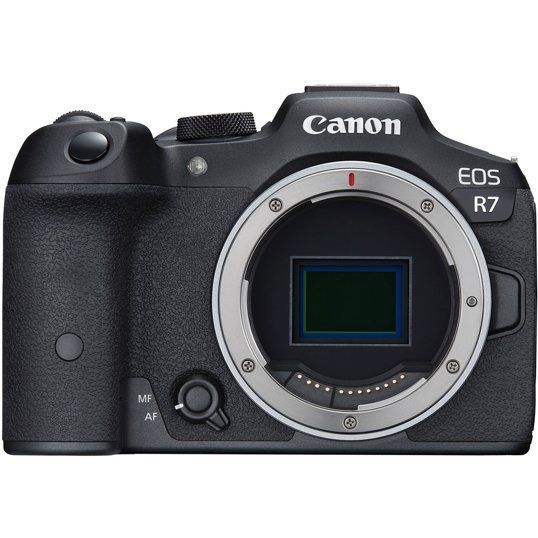
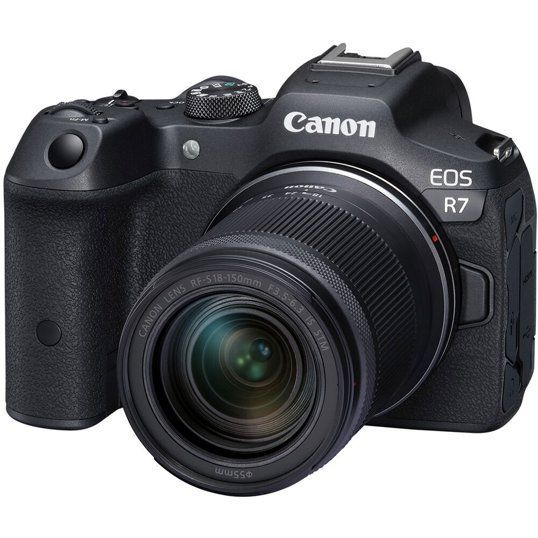
Chelsea: The R7 has a 32-megapixel sensor, and if you spend an extra $500, you can get this 18-150mm kit lens, which is really nice, actually, because it has a lot of range. If you're shooting your kids' sports or something, you might appreciate that extra reach, but it also acts pretty well as a macro lens. So, I'm able to get these bee photos even though they're really up close. What that also means for an all-around kit is that this is extremely versatile. I can be walking around town and take pictures of my food, take portraits of my family, then go to a sports game later and get a picture of my kid playing soccer or baseball, or whatever they're playing. So, the versatility of this camera is really appealing.
Tony: The Canon R7 has this incredibly useful feature for travel and landscapes: auto level. It'll rotate the sensor to straighten out your pictures. It only rotates a few degrees, but it's enough to make a big difference and save you from rotating and cropping in post. It works for video, too, but there's this little bit of lag that makes it a weird experience. Unfortunately, enabling auto level disables high-speed continuous shutter and electronic first-curtain shutter. Canon, you can't expect people to remember to change the setting on page eight every time they switch between sports and travel. Please give us a firmware update that switches it automatically.
Chelsea: You can also do video with this camera. It has 4K 60 video with no crop. The R6 has that, but it's like $2,600, so that's a good value. And you can add something to your repertoire: family video and photo.
FEATURED CAMERAS
Tony: The R7 offers two 4K 30 modes: fine and, well, not fine. The fine is more detailed. Look at this example and freeze here—enhance. You can see the fine shows the detail in these flowers, which are lost in the standard 4K. But as a penalty, the 4K fine overheats faster. Still, it recorded for a solid 47 minutes indoors in air conditioning. It's not cut off after 30 minutes. Thank you for that, Canon.
Chelsea: If you're shooting a moment you just can't miss, you want to make sure you definitely get your photos, you'll be excited to know that, like a lot of top-end professional cameras, this has two card slots. That means if one gets corrupted, you always have your backup photos on the other card. That's a feature I love. I have had cards be corrupted before, I have lost my photos, and it's heartbreaking.
Tony: In the real world, we just couldn't see a big difference between the R7 and RP. Little things like where the camera focuses, or whether or not the breeze was blowing the flowers, made a bigger difference than the lens and the sensor size. But we did bring it into a test environment. Here's a tripod shot in the middle of the zoom range. Let's zoom in.
Tony: The Canon RP has fewer megapixels but still produces a sharper, more detailed image thanks to a bigger, higher-quality lens. This is true throughout the zoom range, but it was particularly true at the telephoto end of the lenses. The Canon RP's more expensive lens and full-frame sensor produced more detailed results despite the lower megapixel sensor. But what about in low-light environments? These photos were taken at ISO 25600. Let's zoom in. They're both really noisy, of course, but the RP is significantly cleaner, as you'd expect from a full-frame sensor. Here are the results at ISO 6400. If you want low light, you should get the Canon RP.
Tony: So, if this sort of photography sounds like you, you might get better results with the Canon RP and the 24-240mm because this big sensor will also give you more background blur. It'll also give you better low-light performance. But this camera has some distinct disadvantages. First, it does not film in 4K 60. It will only do 1080 at 60 frames per second, full width. If you do 4K, it has to go through this kind of serious crop, and I don't really like that footage, so I just end up filming in HD. It also only has a single card slot compared to the R7's two card slots. And where it really falls down is in action sports auto-focusing. Like, it will really only do about four frames per second if you're doing sports, compared to 30 frames per second, and the auto-focusing just is not as quick.
Tony: Let's compare this against the R7 to see how they do for portraits—pictures of people.
[Music]
Tony: We're going to start with the respective kit lenses, and then we're going to switch to some proper portrait lenses to see how it handles really shallow depth of field.
Chelsea: All right, I'll start with some natural light portraits of Tony. Tony, that looks good. Right away, I noticed the eye autofocus works really well, so you no longer have to move around your autofocus point to find the eye; it automatically draws a box around it, and I can shoot vertically and then horizontal and not have to move it manually. It just finds it.
Chelsea: Tony, could you give me like a, um, like a hair flip moment?
Tony: I don't think I can.
Chelsea: Wait, can I see that hair flip again? All right, can you turn around and move around so I can see how the eye AF tracks you? All right, and then I want to simulate what a child might do because I know that they can be the most difficult to track. So Tony, could you, could you act like a five-year-old?
Tony: I want crackers!
Chelsea: Wait, could you be a little more like a, more chill five-year-old? All right, I think that's a pretty good test. Let's try your RP. So, this also has eye AF. I notice it doesn't seem to be finding the eye as quickly or as frequently; it's often just drawing boxes around his entire face, but sometimes it shows the box and it's not in focus. So, all right, can you move around a little bit? Give me the toddler test. All right, this doesn't seem to be tracking your face as well, actually. I mean, we're really pushing the limits, but...
Tony: The benefits of the Canon RP's full frame and bigger lens are apparent here. Look how much nicer the background blur is on the Canon RP. And zooming in in the shade, you can see the Canon R7's smaller sensor produced a much noisier image, even though we had a longer shutter speed shooting wide open with the kit lenses. The Canon RP just looks so much better.
Tony: Okay, these are some serious portrait lenses. It's the Canon 50mm f1.2 on the Canon R7—that'll make it about an 80mm f1.8 or so—and I have the 85mm f1.2 on the Canon RP. They'll provide similar results, but let's see how they actually work.
Tony: The portraits from both cameras looked amazing, and it would take a trained eye to even notice the difference. But if you look at the RP, the full-frame camera, you can see the bokeh falls off more quickly. The pair here is just blurred a little bit more on the full-frame Canon RP. The depth of field falls off faster, leaving more background blur, keeping the eye sharp but blurring the pores and these flyaways more generally, creating a more flattering photo. But the R7 is good enough for all but the most picky portrait photographers.
Chelsea: These photos look amazing. If you want your very own R7, go to Milford Photo and check it out. They have a bunch of Canon products. They have a huge inventory, and you can buy them right there online. But if you want something to go with your new camera, you can also call Milford Photo. They have an incredibly knowledgeable and passionate staff who's there to answer any of your questions. So go to milfordphoto.com. They have free shipping to any of the 48 contiguous states.
Tony: Thanks, Milford Photo.
Chelsea: All right, that was the general pictures and the portraits. Let's go do sports now. [cheering] So many people ask us about photographing sports, especially for their kids' games, and this seems like a perfect contender for that. So we're going to test out the R7, see how those 30 frames per second work out, and if the autofocus can track me hitting this ball.
Tony: Let's do it. I'm switching to shutter priority at one 1/2000ths of a second so I can freeze the action.
Chelsea: Okay, ready?
Tony: Yeah. 30 frames per second helped me capture that split-second moment when the bat hit the ball. High frames per second have been the secret of professional sports photographers, and now it's finally available for $1,500. Amazing!
Tony: Now I'm going to try the pre-buffering, which saves the 15 pictures before you press the shutter. This allows you to wait until the batter actually hits the ball to decide you want to take pictures, and goes back in time half a second. Let's see how well it works.
Tony: With RAW burst mode enabled, the R7 saved all my images in one 650MB RAW file. Lightroom and other photo editing apps cannot open this. You cannot use your traditional workflow. Canon Digital Photo Professional also didn't work with this yet—hopefully that's coming soon—but you can look at the files on the R7, open the RAW burst file, and you can extract a single image from it. This was okay for one burst, but if I were shooting an entire sports event where I might have hundreds or a thousand of these, this process would be completely unworkable.
Tony: You want to see something kind of interesting? Look at the electronic shutter and how bad the rolling shutter is. I didn't think we'd even see anything with a wiffle ball.
Chelsea: Oh, okay. Let's try the mechanical shutter then.
Tony: Yeah, so I'm using the electronic shutter—that's the only way to get 30 frames per second—but you can see even with this not-so-extreme athlete, we are getting extreme rolling shutter and the bat is really curving. So, if this were a professional athlete, it could be really, really messed up. Let's switch to the mechanical shutter, which should resolve the problem but will drop us down to 15 frames per second.
Chelsea: That's still a lot.
Tony: Not only does switching to the mechanical shutter disable 30 frames per second, but it also turns off the RAW burst mode, so I no longer have that feature. [camera shutter clicks] Oh, that seemed really slow.
Tony: It's not. 15 frames per second is very fast, unless you were expecting to use 30 frames per second. While the mechanical shutter didn't give us nearly as many options, it did eliminate the warpy rolling shutter, giving us nice straight bats and round balls.
Tony: I ran out of buffer there after a couple of seconds, so what I'm going to do is switch from shooting RAW to shooting JPEG, which should let me shoot longer without filling up the limited buffer. We tested the buffering to see how many shots we could take in each of the different modes, and we got the best results using JPEG with the mechanical shutter. That let us shoot 15 frames per second for 12 full seconds, and then it gradually dropped off. Shooting JPEG with the electronic shutter lets you get 30 frames per second for one second—a little too brief to really shoot action—and then it dropped off steeply, quickly dropping to zero frames per second and then jumping back up and down, behaving very erratically. This made it impossible for us to reliably shoot action. If you need to shoot RAW for extra dynamic range—for example, when shooting wildlife—we found the 15 frames per second lasted for about four seconds, and then it quickly dropped off and again went a little bit erratic. If you're shooting RAW, you have to really carefully manage your buffer, especially if you use the electronic shutter, which shot 30 frames per second in the first second but then dropped off to almost nothing. Yeah, that means you get basically one second of RAW shooting.
Tony: Whoa, dang! That was legit scary. That just came at me.
Tony: Now, for more serious photographers, I'm going to try it with the Canon 70-200mm f2.8. This is more challenging because it's going to have more background blur, so if it misses focus, we'll really be able to see it. The 30 frames per second works, but the limitation of the electronic shutter and the rolling shutter that it introduces means it probably won't be Plan A, unless you know the situation isn't going to create distortion. There is a reason that Canon charges $6,000 for the big R3—that one does 30 frames per second without the rolling shutter. So, if you do think it's a problem, you might be faced with a big upgrade. Still, the R7 is the best sports camera I've ever tested at this price point, so I think it's a perfect camera for people doing family sports.
Tony: What next, athlete?
Chelsea: We're done with the intense sports segment, and next we're going to do wildlife. So, let's take this thing out on the kayak and see if we can find some birds.
Tony: Our tandem kayak lets us move silently through the water, getting close to water birds. I steer and paddle while Chelsea shoots, because I'm a gentleman like that.
Chelsea: The electronic shutter's super fast, but you get a lot of rolling shutter with moving subjects when I'm tracking birds. So, I'm going to switch to mechanical shutter and have a lower frames per second, but hopefully not get that rolling shutter.
Chelsea: I want to use the electronic shutter for wildlife. First, the 30 frames per second catches the perfect wing position for flying birds. Also, because it's silent, I can get closer to animals without disturbing them, or freaking them out, or making them fly away. The silent shutter worked okay for still animals, but if the animal moved or I panned the camera, the rolling shutter often ruined the shot. Fortunately, the mechanical shutter solves this problem. Here's a panning shot with the electronic shutter, and here it is with the mechanical shutter. If you do buy the Canon R7, remember to switch to the mechanical shutter for wildlife if your subjects are moving. The good news is that it's quiet at 15 frames per second, and it's still really fast.
Chelsea: One thing that's nice is that this also has five-axis in-body image stabilization, which means I can put my shutter speed a little bit lower and not get as much noise in the photo.
Chelsea: I'm really impressed with the reaction time of this camera, especially for a $1,500 camera. I'm used to shooting with the Sony Alpha 1 or the Canon R5, and I can tell that it's a little bit slower in the autofocus—the frame rate is not as high—but it is still super fast and highly capable of shooting wildlife. The R7's APS-C sensor performed great with the Canon 100-500mm RF lens, giving me a 160-800mm full-frame equivalent angle of view—perfect for wildlife. The 32MP captured intense amounts of detail. In the backlit situations, I was able to recover enough shadow detail from the RAW file to salvage these photos. Don't they look good? For far-away subjects, we also tested the $900 Canon 800mm f11, our favorite pick for first-time wildlife photographers. The R7's animal eye AF was amazing, even though it didn't quite keep up with the much more expensive R5 and R3. However, it's more reliable than the Fuji XT4, the Sony a6600, or even the Nikon Z9. You can see here that it correctly focused on the eye of this heron despite it being way out on the edge of the frame. DSLRs like the Canon 90D probably would have focused on the closest wing. This is a seriously great feature, especially at this price point.
Tony: However, shooting perched songbirds with a 600mm f4 in shallow depth of field, I found that R7 autofocus accuracy varied. Even when the autofocus point was locked down to the eye, I recommend shooting bursts of five to ten pictures in continuous autofocus because you'll get a few front-focused, a few back-focused, and a few with perfect focus. The animal eye AF disappeared when I switched to video, unfortunately. Still, the video quality was amazing, and I love shooting at 4K 60 with an extra crop for a wildlife video.
Tony: We brought the cameras into the studio to do a proper portrait shoot and see how they each performed, and we did find a few differences. First, the R7 eye autofocus is a little snappier, but the RP performed great in here. The RP's sync speed—the fastest shutter speed it can use with studio strobes like this—is 1/160th of a second. That's not that great. The R7 is 1/250th of a second, which is significantly faster, and that's going to be better for freezing the motion of, like, wiggly little kids in the portrait studio. So, here we have a single light setup bouncing off of these V-flats to add a little bit of fill with our gravity backdrop back there. Let's take a look at the results.
[Music]
Chelsea: In conclusion, we give the R7 two thumbs up. It's a great camera.
Tony: I think it's the ultimate camera if you're doing some sports and wildlife. If you're shopping in the $1,500 range, I like it better than the Fujifilm XT4, I like it better than the Sony a6600, or even the Canon 90D DSLR. It brings everything together; it's just an all-around great performer.
Chelsea: But if you're not interested in doing action like wildlife or sports, then you probably want to go with the RP because it's full-frame, it will be better in low-light situations, and it's the same price with the 24-240mm lens.
Tony: I got an email from somebody who just bought the R7. They were upgrading from the 7D Mark II, and they were disappointed. Here's the thing: I think Canon misnamed it. They called it the R7; I think they should have called it the R70 because it is not a natural evolution from the 7D series. It doesn't have that heavy-duty grip, it doesn't have the LCD top screen, but it does outperform the 7D series of cameras, just so you know what you're getting.
Tony: If you're considering buying this, you should also know that Canon only has two APS-C RF lenses for this right now. It is impossible right now to get super wide-angle shots with this unless you adapt an older DSLR lens. So, that would be an advantage of some of the other systems like Sony or Fuji.
Chelsea: If you're thinking about buying a new camera, go to milfordphoto.com. They have a huge selection of cameras, including a lot of Canon cameras. They have an incredibly knowledgeable staff, so you can always call if you have a question, and they can help you pick out your camera, your lens, and whatever gear you might need. They have everything that you'll need as a photographer at Milford Photo, from prints to cameras to film.
Tony: If you're in Connecticut, go in, get your hands on things. But if you're outside of Connecticut, it's really nice to support a small business, so please check out milfordphoto.com.
Chelsea: We're going to be making a tutorial of the R7 soon, so if you do get one and you want to know everything about the camera, subscribe, because that will be coming out soon. Thank you.
Tony: Thanks for watching.